
Human Judgment Is the New Competitive Edge: What We Learned at the 8th Marketing AI Pulse
By Keri Tomsic, PR and Content Lead for the Marketing AI Pulse community
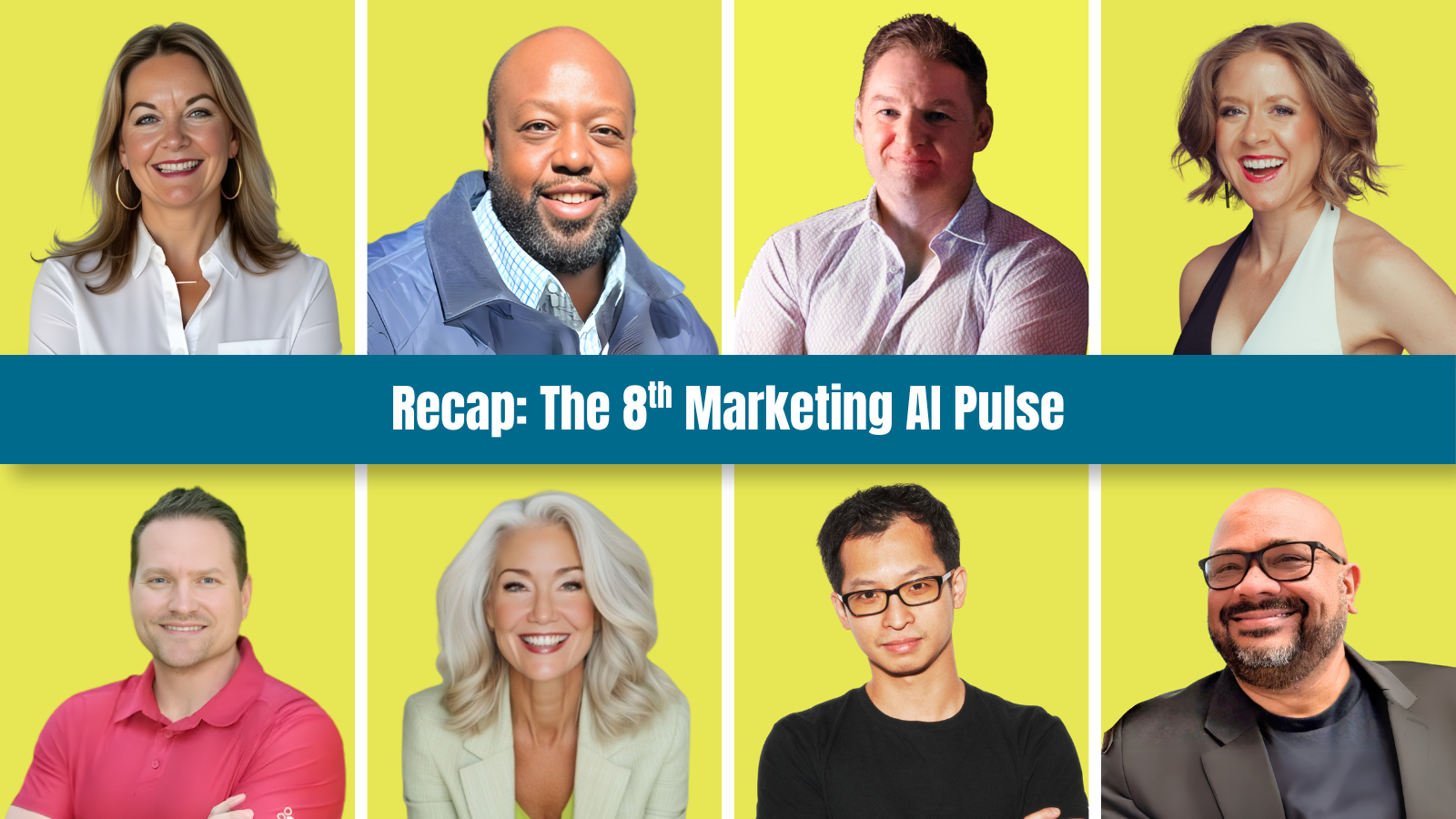
8th Marketing AI Pulse speakers and emcees
In the AI era, your strongest competitive edge is the human skills you already bring to the table. At the 8th Marketing AI Pulse at Atlanta Tech Park, the day was built around applied learning: live demos, real campaign results, and candid discussions on how marketers can put AI to work across their teams. Attendees came to build practical AI fluency and left with actionable frameworks, clear next steps, and a sharper sense of what sets them apart.
Five sessions. One clear theme: the more AI can do, the more your human judgment, creativity, and instincts actually matter.
The Talent Conversation Nobody Wants to Have (But Everyone Needs To)
Amy Mangan from Robert Half kicked off the afternoon, bringing data and a refreshing candor to the room. Yes, AI is eliminating some roles. And yes, it is creating new ones. But the more urgent story is what is surfacing in between: skills gaps that were always there but are now impossible to ignore.
Here is the dynamic nobody is talking about enough. When AI handles the repetitive work, teams suddenly have more time to look up and assess. And what they are finding is that they do not have what they need. Analytics, content strategy, automation, compliance, and paid search are surging in demand. But so are storytelling, communication, and emotional intelligence, because you cannot AI your way out of a difficult conversation with an internal stakeholder, and you cannot automate the judgment it takes to build a real strategy.
And Amy was honest about something teams are quietly struggling with: are leaders and teams actually aligned on the bandwidth required to upskill right now? Knowing you need to learn is not the same as having the time and support to do it. The teams that figure out how to bridge that gap together are the ones that come out ahead.
The takeaway for every marketer in that room: the human skills you may have undervalued are now your most defensible career assets. Invest in them with the same urgency you are bringing to AI literacy.
When AI Becomes Your GTM Engine
Dapo Adeshiyan of Google Cloud walked attendees through what becomes possible when AI stops being an efficiency tool and starts being a business growth engine. The Google GenMedia stack, Gemini 3, Veo for video generation, Chirp3 for text-to-speech, and Lyria, runs on the Agent Studio platform and is designed to let marketing teams move from concept to content to customer feedback in minutes.
He demonstrated building a personalized fragrance campaign video tailored for TikTok versus another platform, showing day-to-night variations, all generated and iterated within a single session. Days and weeks of production are collapsing into hours.
The prompting insight that landed: over-engineering your prompts is a real risk. Too many constraints, too much detail, too many guardrails, and the model delivers something limited and cautious. Give it clear intent and room to work, and you get something genuinely useful. The same instinct that makes a great creative brief works here. Clarity without micromanagement.
The governance question Dapo left the room with was the right one: these tools are available, and increasingly, your teams are using them. But how are they being implemented and managed inside your organization? If you do not have an answer to that yet, now is the time to build one.
Authenticity Is a Strategy, Not a Sentiment
Brian Fallers of Truelio made a case that is both timely and a little uncomfortable: AI fatigue is real, and it is arriving faster than most brands are ready for. People can feel when something is generated without intention behind it. And in that environment, authenticity is not a brand value to put on a slide. It is a competitive advantage.
His Veridigm framework integrates brand, employee, and customer experiences into what he describes as a 3D intelligence system, built on archetypal mapping, voice and tone analysis, and AI-accelerated brand audits.
The formula: authenticity + consistency = trust.
What makes it powerful is the speed at which AI can now surface the archetypal DNA of a company, the patterns and signals that define what a brand actually is versus what it says it is. Many organizations, he noted, do not have a pulse on their own culture. They do not know what they do not know.
AI gives you the analysis at speed. Culture gives you the reason to move. Human wisdom leads while AI accelerates.
Emotion Is Not Soft. It Is Infrastructure.
Deanna Leonard, LinkedIn Top 100 AI Educator, reframed how the room thought about prompting with the often-overlooked truth in the age of AI. Humans feel first, then decide. Every brand, every product, every campaign that has ever worked started with a feeling. If that is true of your customers, it needs to be true of how you brief your AI tools.
Her prompting framework is memorable as it becomes almost poetic. Start with an emotion. End with an emotion. Put the subject in the middle. Leave space between the words. Let the tool do the work. Some of the best outputs, as Deanna shared, come when you stop trying to control everything and give the model creative latitude grounded in emotional intent.
She also shared something practical that surprised people: you can build a working agent in four folders in under an hour. Gemini, she noted, does especially well at generating PRDs. The barrier to building AI-powered workflows is lower than most marketers believe. The real skill is knowing what you want the work to feel like before you ask the machine to help you get there.
Creativity Did Not Get Replaced. It Got Upgraded.
Tor Gundersen of Adobe and Benny Lee, formerly of Coca-Cola, closed the sessions with something the day needed: proof. Not a framework or a forecast. A real example of what AI-augmented creative work actually looks like when it is working.
Benny's story: no budget, new brand to launch. The brand was Topo Chico. The tool was Adobe Firefly. What previously took six Coca-Cola associates 6 weeks to produce can now come together in a fraction of the time with AI assistance.
Adobe Firefly boards let teams upload all brand materials into a single workspace, then iterate across platforms, models, and formats simultaneously. Storyboards. Product-in-situ imagery. Color variations. Social adaptations. 3D conversions. All from one centralized creative environment.
Tor walked through the 4-stage workflow that makes this sustainable: ideation, refinement, adaptation, and automation for scale. Each stage has a distinct purpose. Ideation is for exploration and experimentation. Refinement gets you to assets you can actually use. Adaptation takes those assets across formats and platforms. And automation handles the repetitive scaling that used to eat creative teams alive.
One thing worth knowing for risk-conscious brand teams: Adobe Firefly is trained exclusively on Adobe Stock content, which means all outputs are commercially safe and legally indemnified. That matters. Not every AI creative tool offers that, and it is worth asking before you publish.
Benny closed out the 8th edition of Marketing AI Pulse event, reminding us not to chase shiny objects, to remember it’s okay to pivot and explore platforms to suit our team’s needs. “Keep your house. Change the furniture.”
The Thread That Connected Everything
Six speakers. One room. One message that kept surfacing in different forms across every session.
AI is not the destination. It is the accelerator. The marketers who thrive are the ones who bring irreplaceable human judgment, emotional intelligence, and genuine creative perspective to the work.
AI handles scale and speed. Humans handle meaning.
That is what makes Marketing AI Pulse different from a conference or a webinar series. With more than 1,500 members and growing, powered by Spark Novus, this community exists for marketers who are ready to learn through practice, connect with people doing the actual work, and grow in ways that matter for their careers, their teams, and their businesses. It is not a place to watch AI happen to marketing. It is a place to shape what comes next.
Join the community
The 9th Marketing AI Pulse event cannot come soon enough. If you were not in the room this time, make sure you join us in August in Atlanta.
Find out about all of our upcoming events and join the community here.
Frequently Asked Questions
-
According to data from Robert Half, the skills in highest demand are analytics, content strategy, automation, and compliance, but also storytelling, emotional intelligence, and communication. These are the capabilities AI cannot replicate, and they are what differentiate strong marketers in an AI-saturated environment. Strategic judgment and the ability to navigate internal stakeholders remain entirely human territory.
-
If your prompt is longer than a solid creative brief and more prescriptive than a style guide, it is probably over-engineered. Give the model clear intent, relevant context, and enough room to work. Over-constraining your prompts limits the output you get back. Clarity without micromanagement is the goal, same as it is for briefing a talented creative team.
-
It depends entirely on the tool. Different tools carry different risk profiles depending on their training data and licensing terms. Before using AI-generated assets in any brand-critical or paid context, verify the training data source and confirm the tool's indemnification policy.
-
Marketing AI Pulse exists to give marketers a trusted place to learn on how to turn AI’s potential into impact. The community was created for marketing professionals who are ready to learn through practice, connect with peers across industries, and grow through shared knowledge and applied insights.
By bringing together marketing leaders, consultants, agencies, martech providers, and AI practitioners, Marketing AI Pulse creates a safe space for professionals to get the most out of AI. The foundation of the community rests on three values: Learn, Connect, and Grow.
Learn through expert-led sessions, hands-on workshops, and real-world case studies that bring AI’s evolving role in marketing to life.
Connect with peers and innovators who are actively applying AI to reshape how marketing delivers value.
Grow by fueling career growth, fostering intellectual growth, and driving business growth through AI in marketing.