
AI ROI in Marketing: Why AI Alone Is Not Enough
By Aby Varma, Founder & CEO of Spark Novus and Marketing AI Pulse
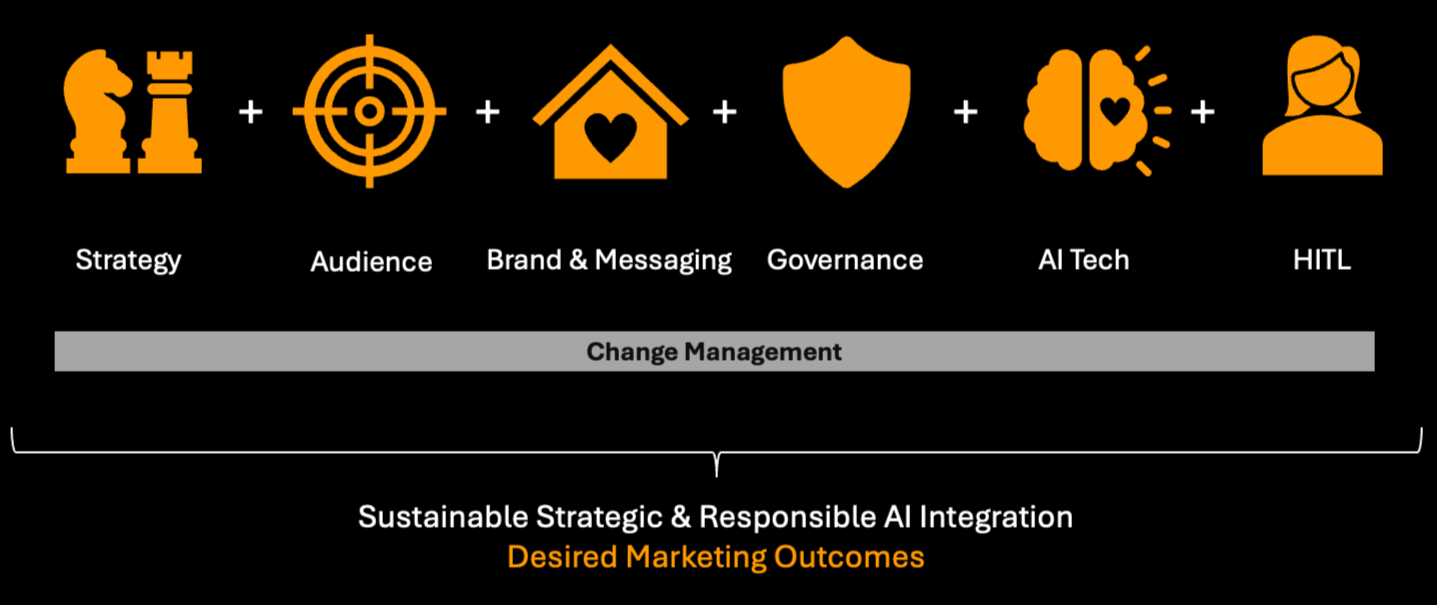
AI can accelerate marketing without improving it.
That may sound counterintuitive, but it’s a pattern I’ve observed repeatedly.
Marketing teams are creating more content, moving faster, automating workflows and experimenting with AI at an unprecedented pace. Yet many organizations are still struggling to improve the business outcomes that matter most.
Campaigns launch faster. Content production scales. Workflows become more efficient. But faster doesn’t automatically mean better.
That observation led me to a simple hypothesis: AI is only one layer of creating marketing value.
Technology can amplify what’s already working. It can also amplify what’s broken. If strategy lacks focus, AI accelerates the wrong work. If messaging is inconsistent, AI scales inconsistency. If customer understanding is weak, AI generates generic marketing faster than ever before.
This isn’t just my observation. Research across the industry points in the same direction. Marketing leaders have largely moved beyond asking whether they should use AI. The conversation has shifted to proving business impact, measuring ROI and embedding AI into marketing operations responsibly. Organizations with greater AI maturity consistently outperform those still treating AI as a collection of disconnected tools.
Over time, I’ve noticed that organizations creating the greatest return from AI consistently get seven things right. Technology is one of them, but it’s rarely the starting point.
Strategy Comes Before Technology
Every successful AI initiative starts with a business objective, not a tool.
One of the most common mistakes I see is organizations beginning with the question: “Where can we use AI?”
It’s the wrong question. A better question is: “What business outcome are we trying to improve?”
Marketing success looks different for every organization. It may mean increasing pipeline contribution, improving campaign performance, accelerating speed to market, reducing customer acquisition costs, increasing customer lifetime value or strengthening the customer experience.
AI should improve one or more of those outcomes. Otherwise, it simply creates more activity.
I’ve seen organizations cut campaign production time in half while seeing little improvement in campaign performance because the underlying positioning and strategy never changed.
AI accelerated execution. It didn’t improve marketing.
When AI initiatives are tied directly to business priorities, investment decisions become clearer, success becomes measurable and AI shifts from being a productivity tool to becoming a business capability.
Strategy provides direction. Without direction, acceleration simply gets you to the wrong destination faster.
Customer Context Is Your Competitive Advantage
AI knows a remarkable amount about the world. It knows almost nothing about your customers until you teach it.
That’s where many organizations unintentionally create average marketing. They ask AI to write an email, generate a campaign, create a landing page or develop messaging. But they never provide the context that differentiates their business.
Who is your ideal customer? What problems are they trying to solve? What motivates them? What objections do they have? How do they buy? Why do they choose you instead of a competitor?
Without those answers, AI fills the gaps with generalized knowledge. The result is content that sounds polished but could belong to almost any company.
Generic marketing isn’t an AI problem. It’s a context problem.
The strongest marketing organizations don’t simply prompt AI. They teach it. They provide customer research, voice of customer insights, competitive intelligence, buyer personas, journey maps and historical performance so AI can generate work grounded in their reality instead of the internet’s average.
Customer context transforms AI from a content generator into a strategic marketing capability.
Brand Is More Than Tone of Voice
Many organizations reduce brand guidance to a style guide and a few prompt instructions. That’s no longer enough.
AI should understand your brand before it represents your brand. That includes your positioning, your value proposition, your messaging hierarchy, your personality, your visual identity, your terminology, your perspective on the market and your competitive differentiation.
When those elements are consistently available, AI becomes significantly more effective because every output reinforces the same brand identity.
Without them, every prompt becomes an isolated exercise. One campaign sounds formal. The next sounds conversational. A third begins to resemble your competitors.
Brand inconsistency isn’t created by AI. AI simply exposes inconsistencies that already existed.
Organizations with strong brands don’t rely on prompt engineering to maintain consistency. They build brand intelligence into the way AI works. That creates more consistent messaging, faster onboarding, stronger customer recognition and better long-term brand equity.
Marketing Specific AI Governance
Every marketing organization needs AI governance. Not the kind that arrives as a 75-page policy written for the entire enterprise. Marketing needs practical guidance that helps teams move quickly while protecting the brand.
Marketing specific AI governance should answer three questions.
What goes into AI?
Define what information can and cannot be shared with AI systems. Customer data, confidential information, competitive intelligence and intellectual property all require different levels of protection.
What comes out of AI?
Establish expectations for accuracy, quality, legal review, bias, accessibility and brand consistency before AI-generated content reaches customers.
When should AI be disclosed?
Not every use of AI requires disclosure. Internal brainstorming, summarization and drafting generally do not. Customer-facing experiences, synthetic media and situations where AI materially influences a customer’s experience should be transparent and consistent with your organization’s policies and applicable regulations.
The goal isn’t to slow marketing down. The goal is to help marketing move faster with confidence.
Strong governance creates consistency. Consistency builds trust.
Technology Should Support the Strategy, Not Become the Strategy
Technology is often where organizations begin. Ironically, it’s where they should spend the least amount of time initially.
The question is no longer which large language model is best. Marketing leaders now have access to an expanding ecosystem of AI-native applications, AI-infused marketing platforms, intelligent agents and increasingly autonomous workflows. Scott Brinker and Frans Riemersma describe this evolution as AI becoming embedded throughout the marketing technology stack rather than existing as a standalone capability.
The challenge is deciding where AI belongs across your marketing ecosystem.
Some capabilities are best handled by general purpose AI assistants. Others belong inside your CRM, customer data platform, marketing automation platform, analytics tools or creative applications where AI has access to the right customer, campaign and performance data.
Technology decisions should answer questions such as: Does this improve an important business outcome? Does it integrate with our existing marketing ecosystem? Does it strengthen customer experience? Does it reduce friction for our team? Can we govern it responsibly? Can we measure its impact?
The organizations creating the greatest ROI are building connected AI ecosystems, not accumulating disconnected AI tools.
Technology provides capability. It doesn’t create strategy.
Human Judgment Remains a Competitive Advantage
As AI becomes more capable, the value of human expertise in the form of human-in-the-loop (HITL) doesn’t disappear. It changes.
AI can analyze, recommend, generate and automate. What it cannot do is own accountability.
Marketing leaders still make decisions about positioning, investment, ethics, customer experience, risk and long-term brand reputation. Those decisions require context that extends beyond data.
The best marketing organizations don’t think about people versus AI. They think about people working with AI. AI handles repetitive work. People provide judgment. That’s where competitive advantage increasingly lives.
Change Management Turns AI Into Sustainable Performance
Technology implementation is rarely the hardest part of AI. People are.
Organizations that generate lasting business value invest as much in change management as they do in technology. That means building AI literacy across the marketing team, creating opportunities for experimentation, sharing success stories, developing new skills, giving teams permission to learn, aligning leaders around common goals and establishing clear expectations for responsible AI use.
Research consistently shows that organizations with greater AI maturity achieve stronger outcomes because they invest in people, governance and operating practices alongside technology.
Change management isn’t a one-time initiative. It’s an ongoing capability. Without it, AI adoption stalls. With it, AI becomes embedded in how marketing operates.
Conclusion
I started with a hypothesis: AI can accelerate marketing without improving it.
The more organizations I work with, the more convinced I become that the hypothesis is true.
Technology matters. But technology alone doesn’t create marketing ROI.
The organizations seeing the greatest returns from AI don’t simply use more AI. They align AI to business strategy. They deeply understand their customers. They equip AI with their brand. They establish practical governance. They build the right technology ecosystem. They preserve human judgment. And they invest in change management.
None of these elements is sufficient on its own. Together, they create the conditions for AI to improve marketing performance in a meaningful and sustainable way.
AI can absolutely accelerate marketing. The real opportunity is making sure it accelerates the outcomes that matter most.
Strategic Takeaway
AI does not create marketing ROI on its own. It amplifies whatever strategy, brand clarity and customer understanding already exist in an organization. The marketing teams generating the strongest returns treat AI as one part of a larger system — anchored in business strategy, fed by real customer context, guided by brand intelligence, protected by practical governance, supported by the right technology ecosystem, and shaped by human judgment and sustained change management.
Ready to Turn AI Into Measurable Marketing ROI?
Spark Novus helps marketing organizations align AI to strategy, customer context, brand intelligence, governance and change management — the conditions that turn AI activity into AI performance. Contact Spark Novus to talk through where your marketing AI strategy stands today.
Sources
Gartner. “2026 CMO Spend Survey Finds CMOs Allocate 15.3% of Marketing Budgets to AI, But Only 30% Are Ready to Scale AI Capabilities.” Gartner, May 2026.
The CMO Survey. “Highlights and Insights Report 2026.” April 2026.
Brinker, Scott, and Frans Riemersma. “State of Martech 2026.” Chiefmartec and MartechTribe, May 2026.
Boston Consulting Group. “Moving the Agentic Marketing Transformation from Illusion to Reality.” BCG, 2026.
Frequently Asked Questions
-
AI amplifies existing marketing strategy, brand clarity and customer understanding — it does not create them. When those foundations are weak, AI produces more content and faster campaigns without improving results. ROI comes from combining AI with clear strategy, customer context, brand intelligence, governance and human judgment.
-
AI maturity describes how deeply a marketing organization has embedded AI into strategy, data, workflows and governance, rather than using it as a standalone tool. Most marketing organizations still allocate meaningful budget to AI without having the readiness to scale it responsibly, which is why maturity — not spend — is the better predictor of return.
-
Marketing leaders should tie AI initiatives to specific business outcomes — pipeline contribution, campaign performance, cost per acquisition or customer lifetime value — rather than tracking AI adoption for its own sake. Most marketers still struggle to isolate AI's incremental impact using rigorous, controlled measurement methods, which makes outcome-based tracking more important than activity-based tracking.
-
Marketing specific AI governance answers three practical questions: what information can be shared with AI systems, what standards generated content must meet before reaching customers, and when AI use should be disclosed. It is meant to be lightweight and usable, not an enterprise-wide policy document.
-
Both, depending on the task. General purpose AI assistants work well for research, drafting and analysis. Capabilities that need customer, campaign and performance data are often better handled inside a CRM, customer data platform, marketing automation platform or analytics tool where that data already lives. AI is increasingly becoming embedded throughout the marketing technology stack rather than existing as a standalone capability.
-
No. AI increases the volume of analysis, content and recommendations available to marketers, but people remain accountable for decisions about positioning, investment, risk, ethics and long-term brand reputation. The organizations gaining the most from AI treat it as a capability that supports human judgment, not a replacement for it.
-
As much as it invests in the technology itself. Organizations that treat AI adoption as ready to scale — not just funded — consistently invest more deliberately in training, experimentation and clear expectations for responsible use, and that investment is what turns AI spend into AI performance.