
Unlocking Human Potential with AI
By guest contributors: Dr. Paul Nieminen & Rita Farin from The Humanized Co. For more on their background, perspective, and experience, see the bio below.

While there's a lot of conversation about AI job loss, we also know it creates new opportunities to reimagine the way we work. We are within a perfect window for us to humanize AI. Not to just consider humans in the loop, but to leverage people's judgment, agency, and intention to reach business goals.
AI implementation requires us to revisit processes, workflows, talents, and abilities. Every workflow you crack open is now a workflow you can redesign around people-first values, or as we call it, humanization. Every role you redefine is now a chance to lean into the subjectivity and judgment that each person uniquely brings.
At a time when workers are increasingly disengaged, the question to ask is how we use AI to enhance what they do—creating better work, better lives, and better humans.
What LLMs are trained on
The large language models powering Claude, ChatGPT, and the rest were trained on the dominant Trade-off Paradigm of business. It's the model taught in business school and practiced in most companies that leads to treating people as a means to an end. This dominant paradigm is dehumanizing because it trades off compassion, empathy, and employee agency to reach business goals.
From our observation in working with the LLMs, this is the default voice in our AI tools. Ask a model to map a workflow, define a role, or draft a policy, and you'll get something well-organized, efficient, and quietly dehumanized. Not because the model is broken, but because the source material is from the dominant Trade-off Paradigm.
Applying a new model
Based on Dr. Nieminen's research, he estimates that 20% of organizations operate from what we call the Humanized Paradigm—a non-dominant approach where people are the purpose. They are expected to learn from one another to solve problems and deliver results by putting people first. When people are prioritized and trusted, all stakeholders, including shareholders, benefit. These humanized companies often outperform their peers. And they make decisions, design processes, and run transformations differently from the start.
When you apply humanized practices to your AI initiatives, you begin to unlock human potential. Here's how:
Agency. Humanized companies give their people agency to make decisions and adapt processes to different situations. In AI transformation, it's critical to build workflows that accommodate human judgment and flexibility. Because people are the ones who will continue to determine the right thing to do for each unique employee, customer, and vendor situation—especially when using AI.
People-first Implementation. Before humanized companies decide to implement AI, they ask these questions for every function: do our employees need it to do their jobs, will they benefit from it, and does it align with our company values? If yes, then the roles are redefined, wide guardrails are provided, and employees are trusted to apply the new AI-adapted processes to do what's best for the company and stakeholders. With these new roles and wide guardrails, people can then apply and build their personal strengths in ways that are meaningful to them.
Shaping AI. People are the fundamental drivers of work, not AI. To drive that work, people need to infuse compassion, empathy, choice, and other human conditions directly into each workflow. We need to review every input, output, decision, and success criterion to identify and document exactly where we infuse those human conditions. The more you apply humanized practices and criteria when you work with AI, the more its output reflects humanized thinking instead of the default trade-off logic.
Double Feedback Loop. Humanized AI leaders seek feedback from every level of the organization, process it, learn from it, incorporate it, and feed it back to the organization by designing and adjusting AI workflows. Employees recognize their own feedback, which builds trust and reciprocity. Over time, these humanized AI workflows propel people and organizations to grow and thrive.
What this looks like in a real workflow
At the Close It Summit, we walked a room of workforce-development leaders through an exercise: take a typical employee development plan workflow and apply the Humanized Framework to it.
We used Claude to generate the starting workflow, and it looked like what you'd expect—the same logic baked into Workday, Cornerstone, and the other major HR platforms. Define competencies. Pull performance data. Match to job models. Generate plan.
It was efficient. It was also designed entirely from the top down, with employees as recipients rather than participants. A perfectly representative product of the Trade-off Paradigm.
By applying three tenets of the Humanized Framework, the process shifted to put people at the center:
Flexible processes and policies to capture and align to human potential, seen through the eyes of the employee. The plan adapts to the individual—life circumstances, career paths beyond the standard track, what the person uniquely brings.
Bottom-up feedback from all involved, not just from the top down. Employees feel safe to reveal their real development areas, not just the ones that fit the system.
Value-based decision making ensures all steps in the process are aligned to company values. The AI-generated plan is held accountable to the values, not the other way around.
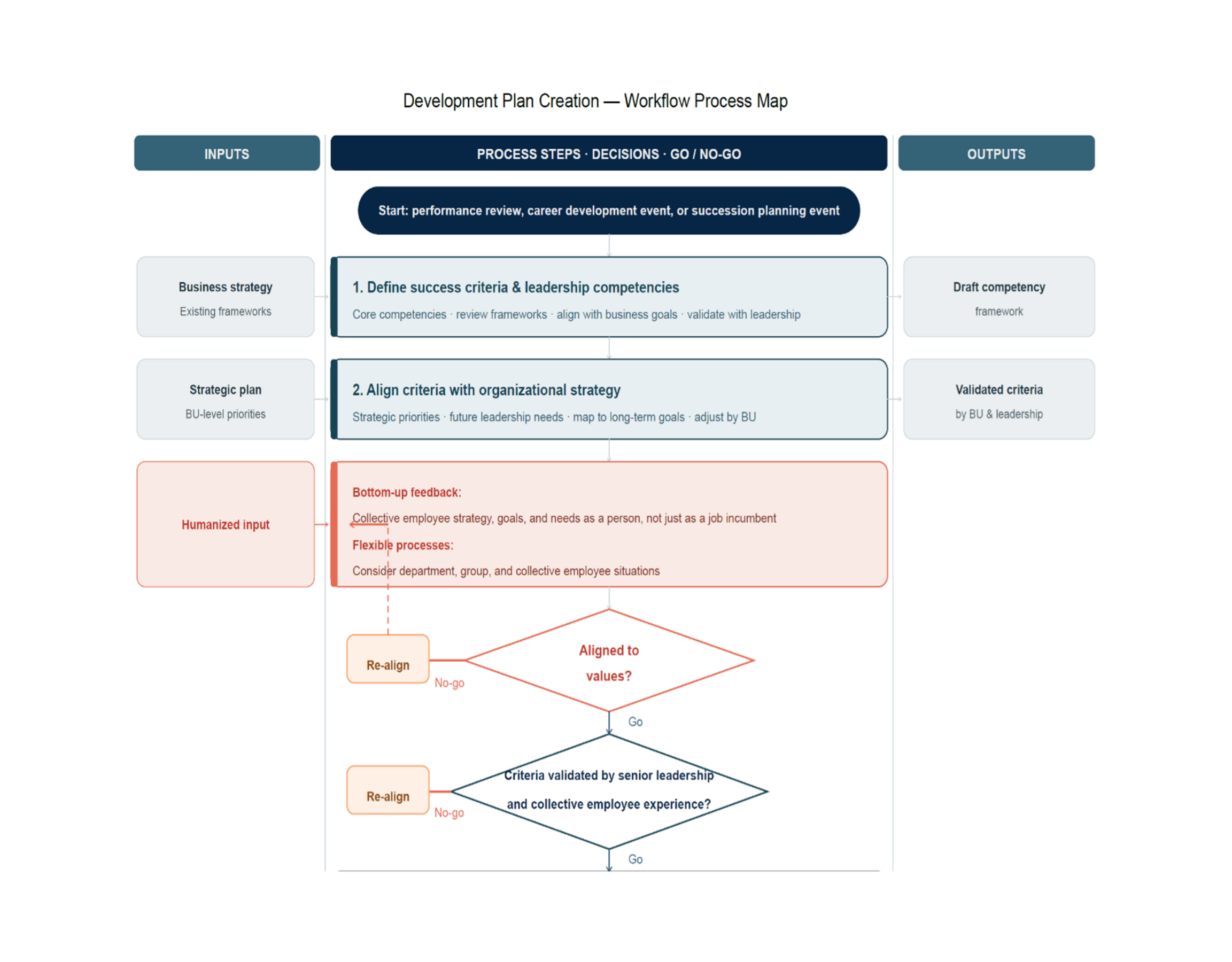
The workflow still uses AI to do what AI does well—match assessments to skills, align development to strategy, surface patterns across the workforce. But it also makes room for what only humans can do: apply context, exercise agency, hold the plan accountable to the company's values.
This is a first step. From here, the real reimagining begins—where AI and humanization are designed together, function by function, with people across the organization deciding where AI belongs and where it doesn't.
Humans in the loop isn't enough. The point is to keep humans leading, and let AI enhance what they do best.
Questions worth asking
If you're leading or advising on an AI initiative, here are questions worth discussing:
How can you use AI to unleash potential in your employees?
How can you leverage people's judgment, agency, and intention with AI?
How can humanized AI help you achieve business outcomes?
How well do your AI initiatives align with your company values?
What would the outcome be for your organization if you trained your AI assistant with a humanized framework?
To what extent does your company trust and give people agency to implement AI workflows?
How can you incorporate feedback from all levels of your organization into your AI workflows?
The companies asking these questions are the ones building workplaces and workforces that use AI as an opportunity to reimagine how we work—giving people agency to lead the way forward and unleashing their full potential.
NOTE: The concepts in this blog are based on the humanized-company research conducted by Dr. Paul Nieminen, CEO of The Humanized Co. The Humanized Co. provides training and consulting services that help organizations build and preserve their people-first cultures. To receive a full copy of the humanized workflow shown here or to learn more visit thehumanizedco.com.
About The Authors
Dr. Paul Nieminen, CEO
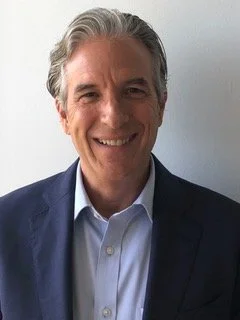
Dr. Paul Nieminen is a globally recognized leader in Organizational Development and Culture, with long-tenured executive roles at Global 50 companies. He's led large-scale transformations, developed enterprise learning strategies and flagship leadership programs, and facilitated innovation teams across Europe, Asia, and Latin America. Paul's culture analyses have shaped mergers, employee engagement, and enterprise change initiatives. His upcoming book focuses on his deep research into humanized organizations, what makes them thrive, and how they can operationalize humanization going forward.
Rita Farin, CMO

Rita Farin is an award-winning marketer who builds teams, strategies, and brands that drive growth for global B2B companies. Across leadership roles at HP, Ciena, and Stanley Black & Decker, plus two consultancies of her own, she has architected innovative awareness-to-demand generation models and campaigns that consistently outperform industry benchmarks. Rita is known for putting people first and developing future leaders. As Co-Founder of The Humanized Co., she helps shape a humanized approach to AI that keeps people at the center.
Ready to Explore AI for Your Marketing Team?
Whether you're just getting started or looking to scale, Spark Novus helps marketing teams build the skills, systems, and strategy to use AI with confidence. Let's talk.
Frequently Asked Questions
-
The Humanized Paradigm is a nondominant business approach identified in Dr. Paul Nieminen’s research in which people are the purpose, not a means to an end. An estimated 20% of organizations operate this way, and these companies often outperform their peers.
-
Large language models were trained on material shaped by the dominant Trade-off Paradigm taught in business schools, so their default output is well-organized and efficient but trades off compassion, empathy and employee agency to reach business goals.
-
It means going beyond humans in the loop. Workflows are designed around people’s judgment, agency and intention, and compassion, empathy and choice are infused into every input, output, decision and success criterion so AI output reflects humanized thinking.
-
For every function, humanized companies ask: Do our employees need it to do their jobs? Will they benefit from it? Does it align with our company values? If yes, roles are redefined, wide guardrails are provided and employees are trusted to apply the new AI-adapted processes.
-
Humanized AI leaders seek feedback from every level of the organization, learn from it, incorporate it and feed it back by designing and adjusting AI workflows. Employees recognize their own feedback in the results, which builds trust and reciprocity over time.
-
In an employee development plan example, applying three tenets - flexible processes and policies, bottom-up feedback and value-based decision making - shifted a top-down, system-driven plan into one that puts employees at the center while AI still handles pattern matching and alignment.
-
Dr. Paul Nieminen, CEO, is a globally recognized leader in organizational development and culture whose research underpins the humanized-company model. Rita Farin, CMO and co-founder, is an award-winning B2B marketer. Learn more at thehumanizedco.com or email info@thehumanizedco.com.