
Inside the Marketing AI Pulse Executive Forum: A Fireside Chat with McKinsey’s Julie Lowrie on AI in Marketing
By: Angela Hoidas | VP of Marketing and Operations, Spark Novus; Community Leader, Marketing AI Pulse
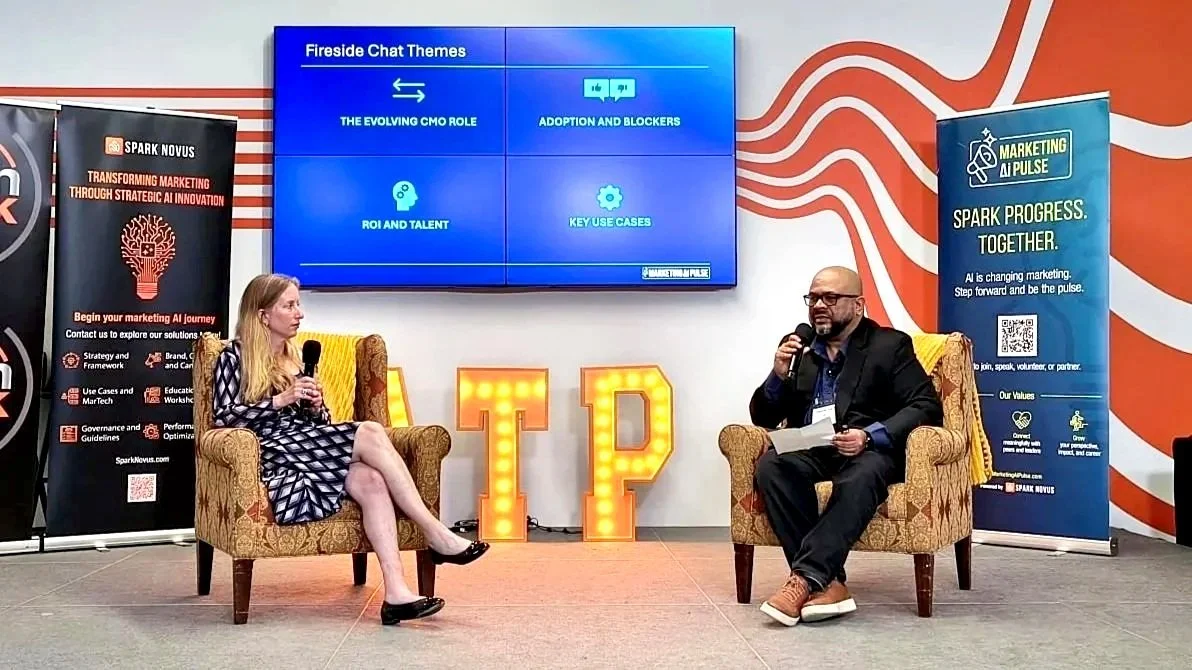
When a McKinsey & Company partner who has spent two decades advising CMOs sits down for a candid conversation about AI, you lean in. That's exactly what happened at our most recent Marketing AI Pulse Executive Forum, where Aby Varma, founder and CEO of Spark Novus, interviewed Julie Lowrie, a McKinsey partner whose current work sits at the intersection of AI, marketing, and consumer growth across CPG, retail, healthcare, and beyond.
What followed was a grounded, unfiltered look at where marketing leaders are genuinely succeeding with AI — and where the gap between ambition and reality is still very real. Here are the insights that stuck with me.
The CMO Role Is Becoming a Multidisciplinary Leadership Job
The CMO role is expanding well beyond traditional marketing expertise. Organizations increasingly want leaders who can understand the customer and lead technical teams toward better experiences. One striking example: a non-technical banking leader who identified his customers' top three pain points, broke each process into pieces, and assembled agile teams of business and tech talent to solve them one at a time — cutting loan approval time from 35 days to 5. No tech background required, just clarity on where the customer relationship was broken and who could fix it.
The lesson: the CMOs winning right now aren't necessarily the most technically fluent. They're the ones who know exactly what the customer wants and can find and manage the right tech people to deliver a solution.
Marketing Has Earned Its Seat at the AI Table
Across sectors, marketing use cases — particularly content generation and media optimization — are consistently among the first AI initiatives approved inside organizations. That's not a coincidence. Marketing is generating measurable, visible results early, and that track record is what's earning marketing leaders influence over the broader enterprise AI agenda.
If your team isn't framing its AI wins that way internally, that's influence left on the table.
The Barrier to Scale Isn't Technology — It's Scope and Governance
There's a wide gap between AI ambition and AI reality. Most organizations claiming end-to-end transformation are still running individual pilots rather than true domain-wide change. Two things separate the pilots that stall from the ones that scale.
Think in domains, not use cases. Scoping too narrowly is one of the most common failure modes. A pilot pitched as a single tool rarely builds a business case strong enough to justify investment. Defining a broader sub-process or domain to transform makes the value equation clear.
Build in governance from day one. The organizations that move fastest treat AI projects like products, with monthly or quarterly reviews where teams show progress and compete for continued funding. That cadence keeps pilots from drifting indefinitely and builds the cross-functional trust needed to scale.
CFO Alignment Needs a New Rhythm
Waiting for the annual planning cycle to make one big AI investment ask puts too much weight on a single moment — and competes against every other budget priority at the same time. Organizations securing consistent investment are showing interim progress monthly or quarterly instead: operational metrics like time freed from administrative work or measurable shifts in team behavior, not just P&L movement. These signals build trust and buy the runway needed for financial results to materialize.
It's also worth noting: most internal AI pitches lean heavily on cost savings because they're easier to isolate and prove. But the growth opportunity in AI is just as real — leaving it out of the business case undersells the full picture.
Content and Personalization Are Where AI Is Already Paying Off
The clearest real-world wins right now are in content — specifically, what happens when human creativity is combined with AI's ability to scale and personalize it. A common pattern in CPG: a brand develops one core campaign idea, and AI helps tailor that idea for each individual retail partner, matching tone, consumer profile, and local market context. Work that would take a human team months of tedious iteration gets handled at scale, without replacing the creative spark that started it.
The brand team's creativity doesn't get replaced in this model — the question becomes how many more ideas can be generated, refined, and deployed from that same creative foundation.
Brand Discovery Has Been Rewritten
Ranking number one in traditional Google search no longer means what it used to. AI-powered search tools like Gemini, Perplexity, and ChatGPT operate on entirely different algorithms than keyword-based search — and these aren't just discovery algorithms anymore, they're purchase algorithms. Many brands are still catching up to what that shift means for their strategy.
A digital war-gaming exercise run with the Georgia State Marketing Roundtable illustrated just how fluid this new landscape is: teams played out strategic moves between branded companies and ecosystem players in an AI-search world, and the right answer looked different depending on market position and channel structure. There's no single playbook yet — only a clear signal that the old rules of discovery no longer apply. Expect strategies to change dynamically in the months to come.
AI Is Reshaping Jobs and Junior Members Are Contributing to Upskilling
As AI capabilities evolve faster than most organizations can keep pace with, upskilling has become a priority at every level. Many companies are moving beyond top-down training and building hands-on capability programs that immerse teams directly in the technology itself.
Reverse mentoring is one of the clearest examples of this shift in action. Junior team members are often far more fluent in AI tools than their senior colleagues, and organizations are increasingly tapping into that fluency directly. But the exchange runs both ways: senior leaders bring organizational context and strategic direction, while junior team members bring technical sophistication and hands-on comfort with the tools — and both sides come away sharper for it.
The bigger takeaway is about where the knowledge actually lives. Leaders are being encouraged to look several layers deeper into the organization than they typically interact, since some of the most advanced AI thinking is happening far from the top of the org chart. The organizations building real capability are the ones actively seeking that knowledge out, wherever it lives.
The Throughline
No single tactic ties these insights together, but a common thread runs through them: the leaders making real progress with AI are pairing bold experimentation with discipline. They're rethinking what the CMO role requires, scoping problems by domain instead of by tool, building governance and cadence into how they fund and measure the work, and looking beyond the top of the org chart for the expertise they need.
When Julie was asked for the one piece of advice she'd leave marketing leaders with, she kept it simple: start with the customer pain points, not the technology, and form a real relationship with your CFO built on interim milestones rather than a single annual ask. It's a good reminder that behind every AI initiative, the fundamentals still hold — know where it hurts, know how you'll prove it's working, and bring the right people along for the ride.
About the Author

Angela Hoidas is the VP of Marketing and Operations for Spark Novus. She is also the Community Leader for Marketing AI Pulse, a community powered by Spark Novus dedicated to helping marketing leaders navigate the AI transformation. She works to connect practitioners, surface emerging insights, and build a space where marketers at every level can learn from one another. Angela is passionate about making AI concepts accessible and actionable for marketing teams across industries.
Connect with Angela on LinkedIn.
Frequently Asked Questions
-
How is AI changing the CMO role?
The CMO role is becoming more multidisciplinary, requiring leaders who understand both the customer and technology. According to McKinsey partner Julie Lowrie, the CMOs succeeding today aren't necessarily the most technical — they're the ones who can pinpoint exact customer pain points and assemble the right cross-functional team to solve them. -
Marketing use cases like content generation and media optimization tend to be the first AI initiatives approved inside organizations because they produce early, measurable results. That track record is what earns marketing leaders greater influence over the broader enterprise AI agenda.
-
Most AI pilots stall because they're scoped around a single tool rather than a broader business domain. Organizations that scale successfully define transformation at the domain level and apply real governance — reviewing AI projects monthly or quarterly, the way a product team would.
-
Rather than pushing for one large annual funding ask, marketing leaders should build a regular cadence of showing interim progress — monthly or quarterly — through operational metrics, not just P&L impact. Business cases should also highlight revenue growth potential, not just cost savings, which tend to dominate AI pitches.
-
The clearest wins today are in content: using AI to scale and personalize a single creative idea across multiple markets or retail partners while preserving the human creative spark that generated it in the first place.
-
AI-powered search tools like ChatGPT, Gemini, and Perplexity operate on different algorithms than traditional keyword search — and they're increasingly purchase algorithms, not just discovery ones. Ranking #1 on Google no longer guarantees visibility in AI-generated answers, and brands are still adapting their strategies to this shift.
-
Most organizations are seeing AI evolve marketing roles rather than eliminate them, freeing people to focus on creative and strategic work instead of administrative tasks. Reverse mentoring — where AI-fluent junior employees help upskill senior colleagues — is becoming a common way organizations build capability at every level.