
Why Governance Enables Responsible AI in Marketing
Governance matters because it protects the brand and gives marketing teams the clarity and confidence to use AI responsibly.
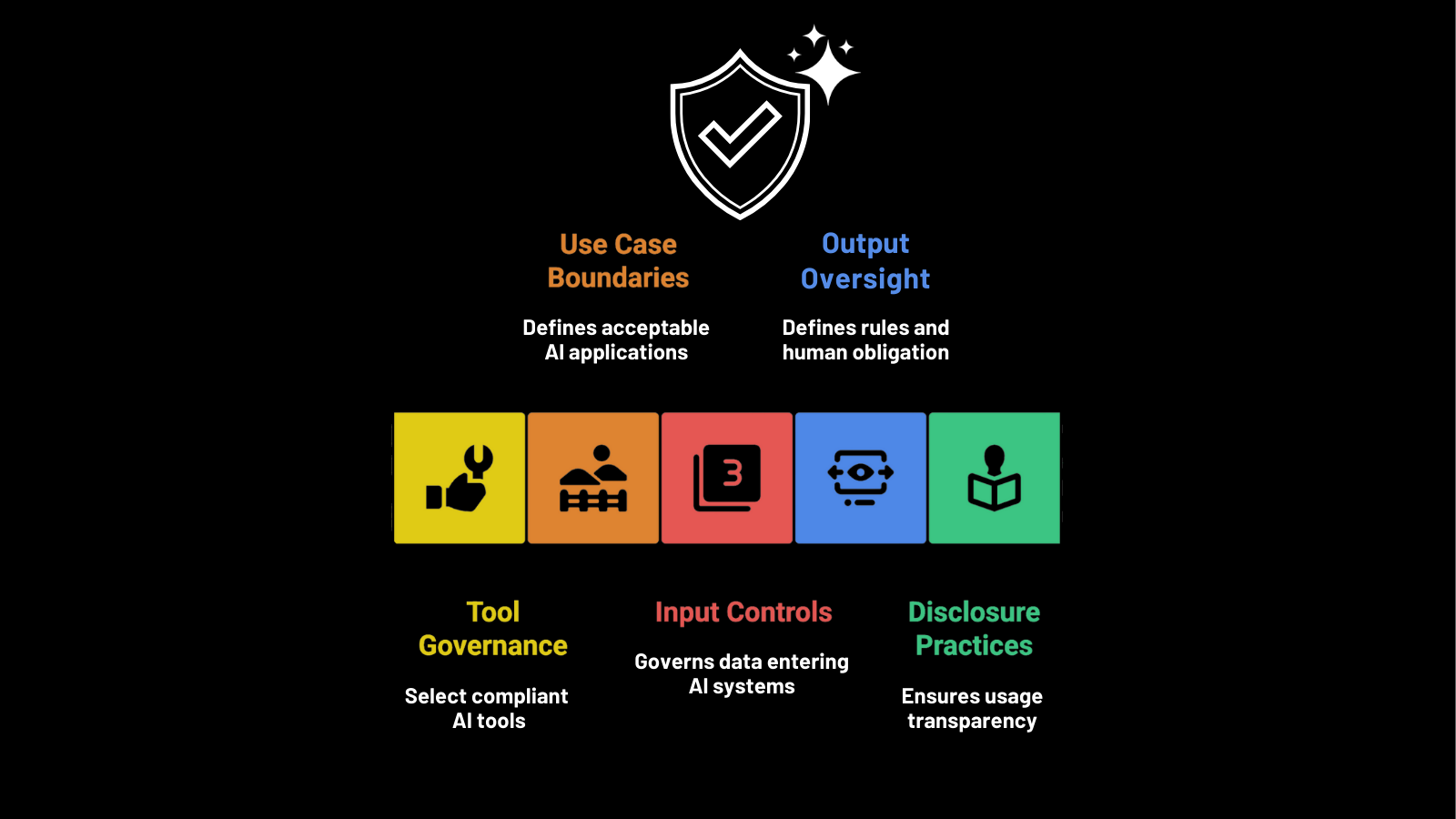
For CMOs, governance is not an afterthought or a legal checkbox. It serves two essential purposes. First, it protects the brand by ensuring that AI generated marketing reflects clear standards for ethics, accuracy, compliance, and trust. Second, it gives teams clarity and comfort. Many marketers hesitate to use AI not because they lack tools, but because they are unsure what is allowed. Governance removes that uncertainty and gives teams confidence that they are operating within the right boundaries.
Governance is not strategy. It is the structure that ensures strategy is executed with control, consistency, and accountability.
Defining the role of governance in marketing AI
Governance is how marketing leaders establish rules, processes, and oversight for AI use. It defines boundaries, ownership, and expectations so AI can be applied safely and consistently across the marketing organization.
This is not about slowing teams down. It is about creating shared understanding. When governance is clear, experimentation increases because marketers know what is approved, what requires review, and what is out of scope.
Why CMOs must own the AI governance conversation
Governance is often assumed to belong to legal, compliance, or IT. In reality, marketing is where AI is most visible to customers through brand voice, messaging, targeting, and experience. That makes governance a marketing leadership responsibility.
A marketing owned governance model ensures decisions reflect how teams actually work. It allows CMOs to align AI usage with brand values while translating enterprise requirements into practical marketing behavior.
The marketing AI governance council
For governance to work, ownership must be clear. Whether it is called a council, task force, steering group, or working committee matters less than its mandate. There must be a designated body responsible for establishing, operationalizing, and maintaining AI governance within marketing.
This group should consist of senior marketers who are trusted, experienced, and deeply familiar with how the organization operates. These leaders work closely with marketing leadership, functional leads, or regional business units depending on structure. They also serve as marketing’s point of coordination with legal, compliance, IT, and procurement.
Examples of where this group typically leads or guides work include:
Steering the validation of AI tools for safety, privacy, and data usage compliance
Shaping and maintaining the approved marketing AI use case library
Supporting scenario planning and risk reviews for new or emerging AI applications
Supporting the design and rollout of AI governance training
Tracking patterns in AI adoption and identifying where teams need additional enablement
Contributing to the evolution of marketing specific AI governance policies
Acting as the escalation point for AI related concerns within marketing
Representing marketing in enterprise AI governance discussions
This structure is what turns governance from a document into a functioning system.
The five pillars of marketing AI governance
Effective marketing AI governance is built on five pillars. Together, they cover the full lifecycle of how AI is selected, used, reviewed, and communicated.
Tool governance
Tool governance is not about choosing the best product. It focuses on validating that the tools selected for marketing use meet safety, privacy, and data usage requirements.
Key considerations include:
Alignment with company data privacy standards
Clarity on data retention, storage, and sharing practices
Defined content ownership and intellectual property terms
Completion of legal, compliance, and security review
Confirmation that intended marketing use cases are permitted by the vendor
Use case boundaries
Not every technically possible AI use aligns with a company’s values or risk tolerance. Use case governance defines what marketing teams agree AI will and will not be used for.
These decisions are cultural as much as technical. For example, one team may allow AI generated avatars or synthetic voice, while another may decide those uses do not align with brand expectations. Governance ensures these decisions are deliberate, documented, and clearly communicated.
Input controls
Input controls define what information marketers can safely provide to AI tools. This is where many compliance risks originate.
Input governance includes:
Prohibiting the use of personal, health, or confidential business data in prompts
Offering prompt examples that model safe and effective inputs
Training teams to recognize and avoid risky or non compliant language
Aligning input rules with enterprise data usage policies
Output oversight
Output oversight ensures AI generated content meets standards for accuracy, tone, ethics, and compliance before it reaches the market.
Oversight processes should include:
Factual verification against reliable sources
Brand tone and voice checks
Ethical alignment reviews to identify bias or harmful framing
Clear escalation paths for regulated or sensitive topics
Compliance checks based on industry and regional requirements
Defined reviewer roles based on content type and risk level
Disclosure practices
Disclosure governance defines when and how AI involvement is communicated. Consistent disclosure builds trust with customers, regulators, and internal teams.
Effective practices include:
Clear guidance on which content types require disclosure
Standardized disclosure language approved by legal and communications
Placement that aligns with user experience and brand tone
A centralized public statement explaining the brand’s use of AI in marketing
Governance requires a formalized rollout
Governance does not work if it only lives in policy documents. It must be rolled out with the same discipline as any major operational initiative.
A formal rollout includes:
Required onboarding for new hires on AI governance expectations
Regular training refreshes as tools and regulations evolve
Practical examples tied to real marketing workflows
Ongoing communication as governance guidance changes
This is how governance becomes part of how teams work, not an obstacle they work around.
Final thought on governance and trust
For CMOs, the greatest AI risk is not technical failure. It is erosion of brand trust. Governance protects that trust while giving teams the confidence to move faster with AI.
When governance is clear, teams act with confidence. When teams act with confidence, innovation follows.
Ready to Put Governance Into Practice
Responsible AI does not happen by accident. It requires clear structure, ownership, and rollout. The Spark Novus Marketing AI Governance Blueprint gives marketing leaders a practical framework to operationalize AI governance without slowing teams down.
Explore the blueprint to see how to move from policy intent to real-world execution, or contact us to discuss your needs.
Marketing AI Governance FAQs
-
Governance protects the brand and gives marketing teams clarity about what is allowed. It reduces risk while enabling confident and responsible AI use.
-
AI strategy defines what the organization wants to achieve. Governance defines the rules, controls, and oversight that ensure those goals are executed safely and consistently.
-
AI governance in marketing should be owned by senior marketing leaders who understand how the team operates and can coordinate with enterprise stakeholders when needed.
-
Input controls define what data and language marketers can safely provide to AI tools, helping prevent privacy violations, compliance risks, and unreliable outputs.
-
Output oversight means reviewing AI generated content for factual accuracy, brand tone, ethical alignment, and regulatory compliance before it is published.
-
AI use should be disclosed when it materially contributes to customer facing content, following clear brand and legal guidelines.